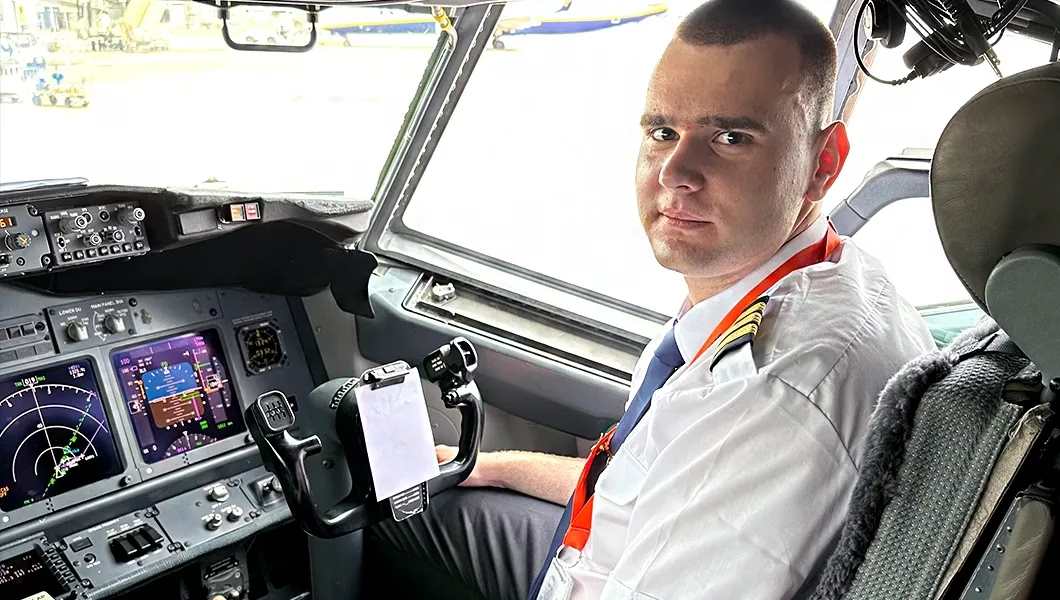
The Pilot Shortage Paradox: Why Many Cadets Still Struggle to Get Their First Airline Job
The aviation industry continues to warn about a growing need for pilots.
Content
In This Article
The shortage is real, but not immediate. Boeing forecasts 674,000 new pilots needed over 20 years, but entry-level hiring stays tight today.
Fleet growth is lagging. Delivery delays and a record order backlog mean airlines often manage with the pilots they already have.
Demand is regional and type-specific. Gulf recruitment is rebounding after a pause. Widebody aircraft are driving the sharpest competition for experienced pilots.
Airlines want more than a CPL. Credentials like APS MCC, simulator readiness, and CRM skills are increasingly deciding factors.
Boeing forecasts that commercial aviation will require 674,000 new pilots over the next two decades, driven by fleet growth and workforce attrition.
Yet for many newly qualified Commercial Pilot License (CPL) holders, the reality feels very different, as competition for entry-level First Officer positions remains intense, despite persistent pilot shortage forecasts.
So why are airlines struggling to find pilots while aspiring First Officers are struggling to find jobs? The answer lies in a misunderstanding of what today's pilot shortage actually looks like.
There Is No Single Pilot Job Market
The term "pilot shortage" often suggests a single, industry-wide problem. In reality, commercial aviation consists of multiple labor markets, each shaped by different operational needs, fleet strategies and hiring priorities.
The supply of newly trained pilots and current airline demand are simply out of sync. Flight academies continue producing cadets at a steady pace, but airline demand hasn't grown to match. Aircraft delivery delays mean fleets aren't expanding as planned, and high fuel prices have pushed some carriers to park aircraft rather than fly them. The result is that many airlines are able to get by with the pilots they already employ.
This pressure shows up clearly in aircraft delivery data. According to IATA's June 2026 outlook, deliveries were roughly 5,600 aircraft below the pre-pandemic trend, while the global order backlog reached 18,100 aircraft in May 2026 – equivalent to almost 60% of the active fleet. Delays like these can push back the recruitment and training that would otherwise support fleet expansion.
When airlines do recruit, safety and insurance requirements often lead them to favor experienced pilots over newly qualified ones, since experienced hires need less additional training.
Put simply: the long-term shortage forecasts are real, but they describe the next two decades – not today's job market for a low-hour First Officer.
Demand Shifts Between Regions and Aircraft Types
Pilot demand also shifts between regions as airlines respond to geopolitical developments and changing operating conditions. Overall, demand tends to be fairly balanced across regions, but recent geopolitical developments have shifted activity around. The crisis in the Middle East paused recruitment among Gulf carriers for several months, and that uncertainty pushed some pilots back toward Europe, adding to the pool of available candidates there. The Gulf market is now recovering as airlines resume activity and compete again to attract pilots.
Aircraft type is another major factor. There's strong ongoing demand for both First Officers and Captains on the Airbus A320 family and Boeing 737, but the clearest growth trend right now is in the widebody market. Leading carriers are increasingly building their fleets around the Boeing 787 Dreamliner and 777. As new widebody aircraft arrive, particularly in the Gulf, airlines are competing hard to attract experienced pilots from major European and Asian carriers.
Subscribe to BAA Training
The biggest mismatch today isn't in overall pilot numbers – it's in experience and type qualifications. Demand consistently outstrips supply for highly skilled, type-rated pilots, especially on widebodies, and that gap is only expected to widen.
Airlines Are Looking Beyond Basics
Meeting regulatory requirements remains the foundation of every airline career, but securing a first airline job requires more than technical flying ability. Additional credentials and certifications, simulator assessments, behavioral interviews, Crew Resource Management (CRM), decision-making, communication, and overall professionalism are integral parts of many airline selection processes.
Stian Skaar, Head of Training at BAA Training
According to Stian Skaar, Head of Training at BAA Training, a strong profile on paper does not automatically make someone a strong airline candidate.
"Holding a CPL isn't enough anymore. Airlines – particularly low-cost carriers in Europe – increasingly prefer candidates with additional qualifications such as the Airline Pilot Standards Multi-Crew Cooperation Course (APS MCC). It develops the technical and non-technical skills expected of today's pilots."
This preference is already reflected in airline recruitment criteria. Ryanair states that cadet applicants who have completed APS MCC training are given preference during initial selection and have a distinct advantage during the interview and assessment process. British Airways also listed APS MCC as a requirement for its self-sponsored pathway.
Many candidates focus heavily on obtaining their license and building flight hours but devote less attention to airline selection. Simulator assessments, behavioral interviews, operator research and non-technical competencies are often overlooked until the first assessment invitation arrives.
What Helps Candidates Stand Out
Airline-oriented courses, like APS MCC, can help bridge the gap between obtaining a license and entering commercial operations. Such training exposes CPL holders to airline-standard procedures, realistic simulator scenarios and Crew Resource Management (CRM) before they begin applying for First Officer positions. At BAA Training, this approach extends beyond helping cadets obtain their licenses. The focus is also on preparing them for airline selection and the operational mindset expected on the flight deck.
"Ultimately, our goal isn't simply to graduate licensed pilots," says Skaar. "It's to help them become pilots who are ready to succeed in an airline recruitment process, transition confidently into commercial operations, and ensure overall aviation safety and standards."
The Shortage Is Real, but So Is the Competition
The pilot shortage is therefore not a contradiction but a question of timing and qualification. Long-term forecasts point to substantial demand across commercial aviation, while today's recruitment decisions are shaped by immediate fleet requirements, regional conditions, aircraft types and the availability of experienced pilots.
For aspiring First Officers, waiting for the forecast shortage to translate automatically into job offers is not a strategy. A CPL opens the door, but candidates still need to understand where demand exists, prepare for airline-specific selection and develop the technical and non-technical skills required to transition into commercial operations.
Author: Karolina Zilenaite
With the background in journalistic writing, Karolina has years of content creation experience under her belt. Tackling all manner of topics across the aviation industry, she aims to bring interesting perspective and spark curiosity.
This website uses cookies. You can express your preference for cookies by selecting one of the options below. If you select the "Allow" option, you agree to the use of all types of cookies, including third party and marketing cookies. You can change your cookie settings or withdraw your consent at any time. Your consent is not required for the recording of the strictly necessary cookies. For more information, please read our
Cookie Policy.
Cookies settings
We use cookies and other similar technologies to help provide our Services, to advertise to you and to analyse how you use our Services and whether advertisements are being viewed. We also allow third parties to use tracking technologies for similar purposes. If you are using our Services via a browser you can restrict, block or remove cookies through your web browser settings.