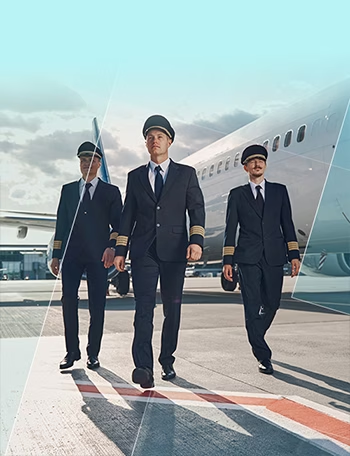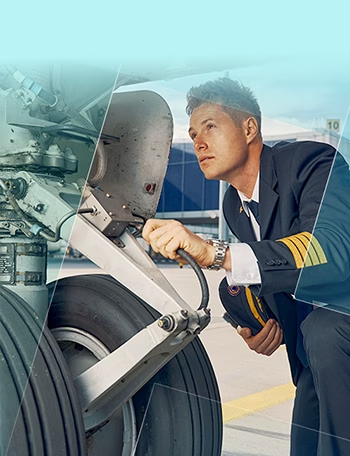
From Type Ratings to qualification and advanced training, we help CPL holders build the credentials airlines are looking for.
“Aviation is proof that given the will, we have the capacity to achieve the impossible.”
Eddie Rickenbacker





Why Choose BAA Training?
With the necessary know-how, facilities, equipment and highly qualified instructors, BAA Training has everything to offer Type Rating and other advanced training of world-class quality.
4 Training Centers
We have three training centers in Europe – Lithuania, Spain and France, and a simulator center in Vietnam. The training centers are suitably equipped to provide Airbus A320, Boeing 737 CL, Boeing 737 NG and Boeing 737 MAX Type Rating, recurrent training, as well as dry/wet lease services. Approved programs are carried out utilizing full flight simulators (FFSs) and flight training devices (FTDs), complying with the latest requirements.
60 FSS in 22 locations
Apart from training on the above mentioned simulators in the specified locations, we have an assess to another 60 simulators in 22 locations through our partnership network in Europe, Africa, and Asia. In total, 24 aircraft types can be covered, including Embraer, ATR, Bombardier CRJ, and others.
2 Million Flight Hours in FFSs
Since its establishment, BAA Training students have accumulated over 2,000,000 flight hours in FFSs.
300 Type Rating Instuctors
BAA Training has a pool of over 300 Type Rating instructors globally.
Richard Gomes de Melo
A320 LPC | Captain at Avion Express
A fantastic, welcoming team.
I have 15 years of experience in commercial aviation, and every year, we always do simulator training, which is part of the strictest rules in world aviation. However, I would like to report that BAA Training is a serious and accessible company with a fantastic team that welcomes customers from the first contact until the end of the training. Respect and helpfulness are the outstanding qualities of this team that will always have my respect. BAA Training Vilnius, thank you very much.
Gabriel Salle Phelippes de la Marniere Pareta
A320 Type Rating | First Officer at Iberia
Excellent flexibility.
I completed my A320 Type Rating at BAA Training Spain in Barcelona for Iberia. Firstly, the Barcelona team provided excellent flexibility, accommodating my busy schedule during the transition from my previous employer. I was guided by highly professional instructors who made the course run smoothly and efficiently. The facilities were top-notch, featuring comfortable briefing rooms and high-quality simulators. Thank you!
Joan Majo Nieto
A320 Type Rating | Airline Pilot at Level Airlines
Instructors are top-tier professionals.
Training for my A320 Type Rating at BAA Training Spain in Barcelona was a great experience. The instructors were top-tier professionals who made the entire process seamless and effective. I also really appreciated the flexibility the Barcelona team provided, allowing me to balance my training with other commitments. The facilities were modern and well-maintained, making for an excellent learning environment.
Ricardo Bortolozo
A320 LPC | Pilot at Avion Express Brasil
Excellent service provided.
I recently completed my last LPC on the A320 at BAA Training Barcelona, and I couldn’t be more satisfied. The new, last-generation simulator, the outstanding instruction team, the fantastic facilities, and the excellent service provided by the BAA Training team all exceeded my expectations. Highly recommended!
Hassan Hacid
A320 Type Rating | First Officer at Avion Express
The training is remarkable.
I had the opportunity to do a Type Rating on the Airbus A320 at BAA Training after having successfully passed the Avion Express selection. BAA Training was the logical choice and, in hindsight, certainly the best. The quality of the training was remarkable, a complex programme optimally organised. Qualified instructors with a wide and varied range of experience, high-level and responsive management. The school has a beautiful and functional building, and the simulators are great. The tools provided are largely as expected, which greatly enhances the learning experience. The experience with BAA Training has definitely been a very good one. Theoretical training takes place online and in person with almost daily supervision, and the instructors really help us. The simulator sessions are also well organised, with periods of rest in order to acquire the learning material. The instructors are of a very high quality and in addition to the learning we have a lot of fun. The Airbus A320 Type Rating at BAA Training has been an enriching experience for me on both a professional and a personal level. The quality of the training enabled me to obtain an A320 First Officer position.
Bruno Coelho
A320 LPC | Captain at VietJet Air
Dedication & professionalism truly stand out.
My experience with BAA Training has been extremely positive. I recently went for my LPC recheck and was very impressed with their facilities and the commitment of the BAA Training team. Their dedication and professionalism truly stand out, and I highly recommend their services.
Coia Cesar Gonzalez
A320 LPC | Captain at Etihad Airways
Very professional examiners & amazing facilities.
I would like to share my very positive thoughts about BAA Training. I just have good things to say about BAA Training, and I will start with Aya Noreldin, who is a Sales Representative. Aya is very kind, and she quickly helps you with everything you need. I have referred Aya to more than ten friends to renew their licenses. Once you jump into the simulator, you have very professional examiners, and amazing facilities, including new simulators. I had LPC with two different Spanish examiners – David in 2023 and Alfonso in 2024. Besides the standard program, they ask you if you would like to train in any other maneuver, and you can “see” and train other maneuvers that you never trained during your checks with your regular company. The examiners are there to show you the different sides of failures. We talk in detail about problems and failures you can experience during the flight. I would like to thank Cpt. Alfonso very much, because after my LPC with BAA Training, I passed an assessment as an A320 Captain with Etihad just a few days later. If you think about renewing or validating your license, don’t think twice. I totally recommend BAA Training.
Pluchon Guillaume
A320 Type Rating | First Officer at Avion Express
BAA Training is the best A320 Type Rating provider.
I did my A320 Type Rating with SmartLynx at the BAA Training center in Barcelona. I signed my contract with the airline to be a First Officer, only a few weeks after the end of the training. Before entering BAA Training, I asked for information, ‘cause for me, BAA Training was the best A320 Type Rating provider for cadet pilots with many opportunities at the end of the training. All the people from BAA Training I met in Barcelona were kind and always here to help. For me, the Type Rating was awesome. Of course, that meant a lot of personal work, but in matters of subjects, time of learning, and behavior, it was just perfect for me!
Florian Devauchelle
A320 Type Rating | First Officer at Avion Express
Everybody is involved in the students' success.
In December, Avion Express contacted me to have an assessment with them, and I successfully completed it in March. I chose BAA Training as my training provider because the Avion Express Cadet Program is in collaboration with the academy for the Type Rating (Airbus A320). There is a very high quality of training. All the instructors have important experience with thousands of flight hours on Airbus. They really push us to give the best, and they explain every exercise in a positive way. The full flight simulators are impressive by how realistic they are, so that we can be really immersed inside the A320 cockpit. I would like to highlight the professionalism of the BAA Training team, which is always mindful of our well-being. Also, Vilnius’ environment is really nice because of this city's and country's atmosphere, where we can feel that we are welcome here. This Type Rating program meets my expectations because we are going through everything, and everybody is involved in the students' success.
Javier Gayoso Jiménez
A320 Type Rating Alumnus
Curriculum covered all necessary aspects.
For my Type Rating, I chose BAA Training because of their reputation for quality training and their partnership with Avion Express, where I’m currently completing the selection process. The training quality was exceptional – instructors demonstrated a high level of professionalism, providing thorough and engaging instructions throughout the program. The training environment was conducive to learning, with state-of-the-art facilities and equipment, including full flight simulators, which greatly enhanced my overall learning experience. The Type Rating program exceeded my expectations in terms of depth and comprehensiveness. The curriculum covered all necessary aspects, ensuring I was well-prepared for my role as First Officer. Overall, my experience with BAA Training was excellent, and I highly recommend them to aspiring pilots.
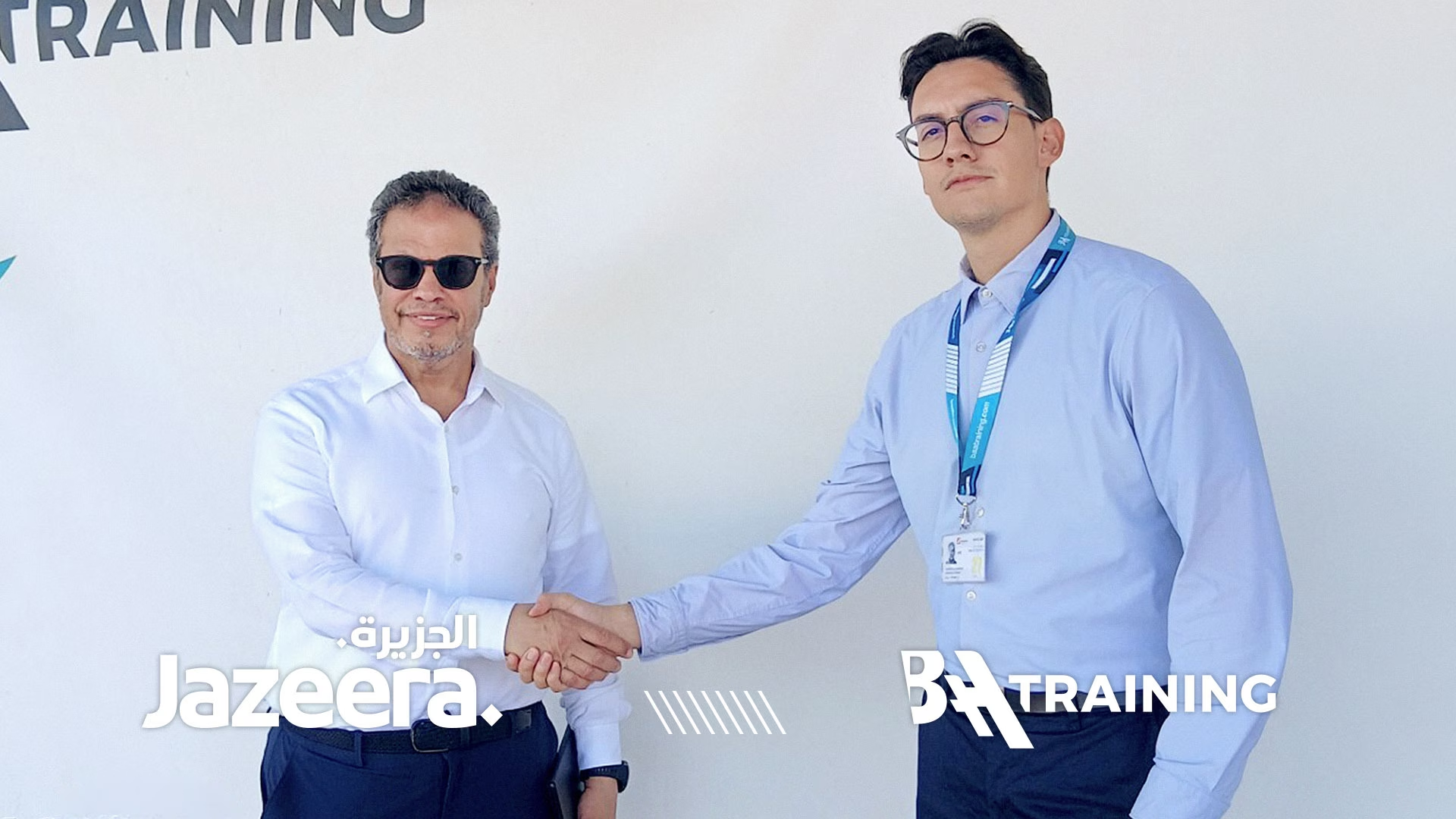
BAA Training has entered a partnership with Kuwait’s leading low-cost carrier (LCC) Jazeera Airways, to provide Airlin...
Read More – BAA Training Partners with Jazeera Airways to Build Future Pilot TalentBAA Training France has signed a financing partnership with Société Générale, one of Europe's leading banking groups,...
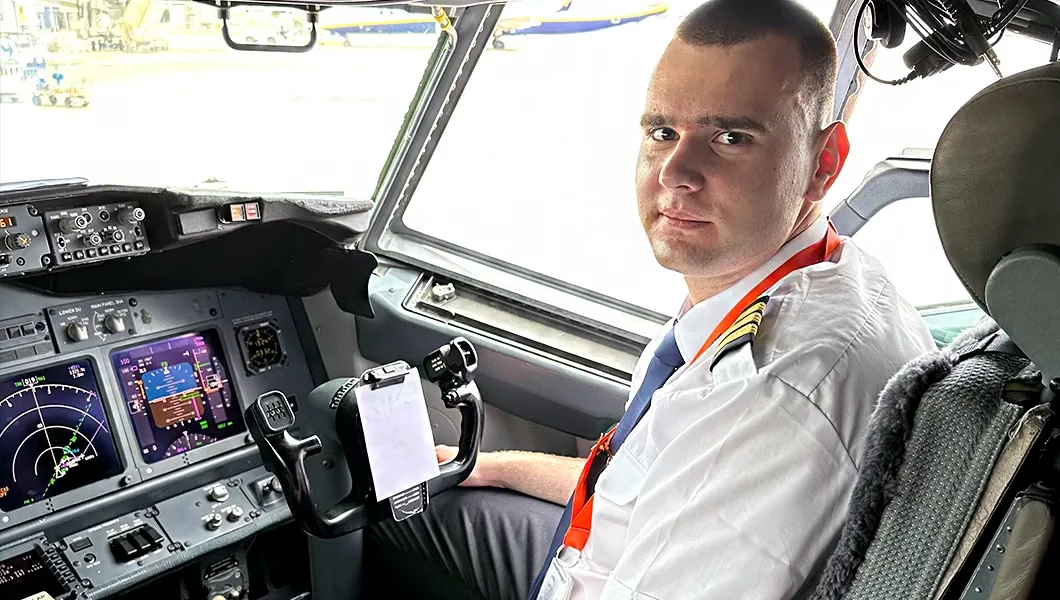
Read More – BAA Training Signs with France's Société Générale for Pilot Training FinancingNow an experienced First Officer at one of the fastest growing air carriers in Europe, Bruno Kotlovski was once a youn...
Read More – BAA Training Alumnus & First Officer Bruno: “Training Prepared Me Well for Real-World Flying”