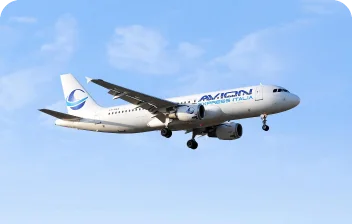
An airline-financed Multi-crew Pilot License (MPL) training program that leads to a guaranteed First Officer position at European partner airlines. It’s your takeoff point to a life as a pilot.
No previous experience needed – just your passion and ambition to fly.
Program is closed for enrolment
-->
What is PILOT RUNWAY?
It’s the fast-track to your financed airline career. Currently open for: Lithuania, Romania, Poland, Bulgaria, and Slovakia.
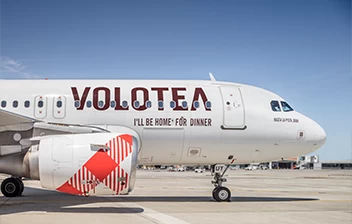
Partner airlines Avion Express and AirExplore will finance your training with a loan covering 90%+ of the cost, repaid over approximately 7 years, once you start working as a First Officer.
You will need to cover the initial payment of €10,000 and 10% annual interest. With accessible financing in place, your path to the First Officer seat starts here.
Efficiently structured to take you from beginner to airline-ready in just ~24 months.
Ab Initio Training
Initial theory and practical training.
Type Rating
Specialized simulator training, certifying for specific aircraft (A320 or B737) flight operations.
Base & Line Training
Hands-on experience operating type aircraft in standard commercial flight procedures.
MPL PROGRAM structure
It is a competency-based MPL (Multi-Crew Pilot License) program that covers Ab Initio flight school training, Type Rating, and Base and Line training. It takes around 24 months (2 years) to complete, and once you graduate, you will proudly join one of our partner airlines as a First Officer.
The program curriculum may vary slightly by airline.
TOTAL DURATION:
24
months
ATPL Theory
CAA Exams
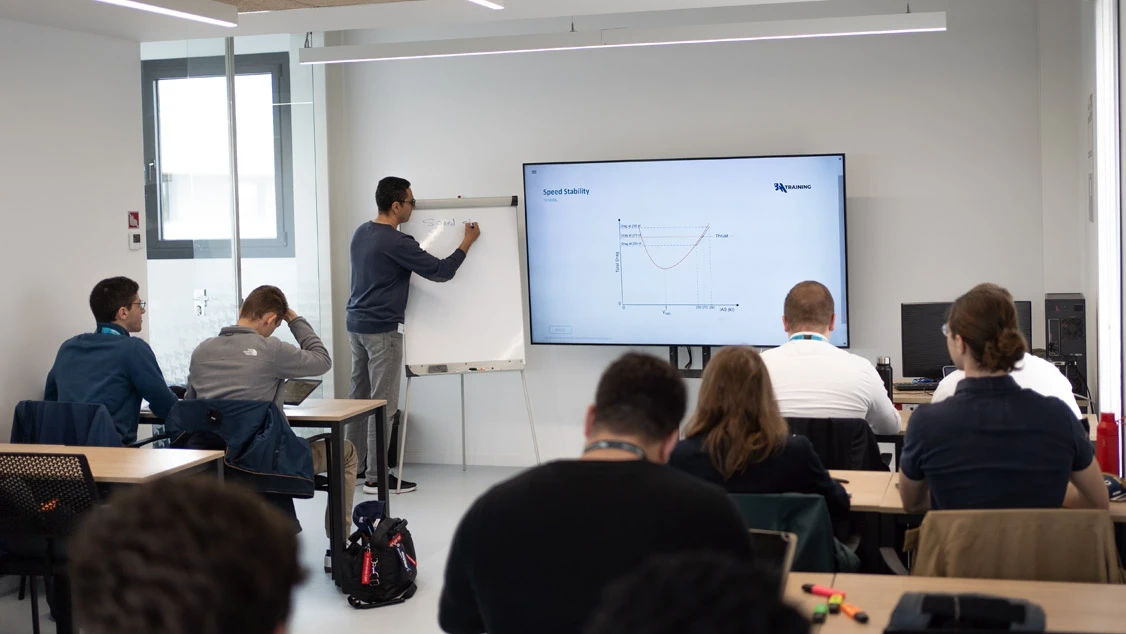
Starting with theory, students develop comprehensive knowledge of aviation, including air law, aircraft systems, navigation techniques, meteorology, and operational procedures.
Covering principles of flight, human factors, and emergency protocols, soon-to-be pilots are prepared for the theoretical aspects of commanding commercial aircraft.
Students also complete BAA Training school exams and are fully prepared for all 13 Civil Aviation Authority (CAA) exams essential to obtain a commercial pilot license, all of which must be taken at the same examination center.
CORE Flying
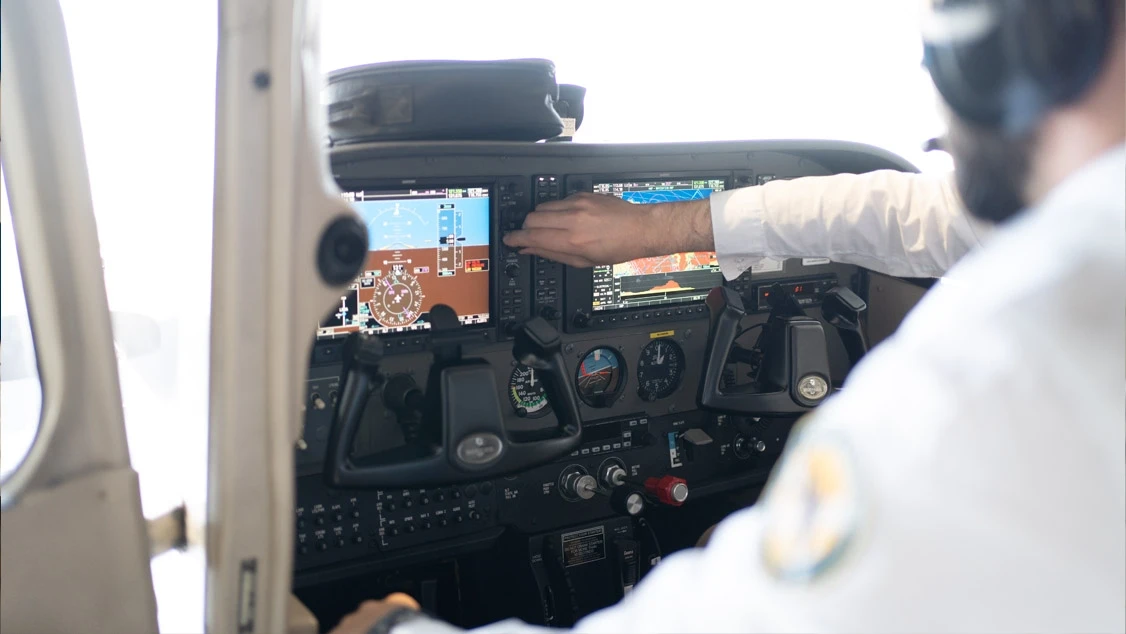
During the practical part of the training, students cover Visual Flight Rules (VFR), including Night Visual Flight Rules (NVFR) on a single-engine piston aircraft, and Instrument Flight Rules (IFR) on a Flight and Navigation Procedures Trainer (FNPT).
BASIC Training
Students are introduced to multi-crew operations and instrument flight.
INTERMEDIATE Training
Students move to theoretical and practical Type Rating studies, conducted in both a classroom and on an FNPT of a specific aircraft type (A320 or B737).
ADVANCED Training
Students continue to expand both theoretical and practical knowledge in the classroom using a type-specific FFS device (A320 or B737), preparing to work in a multi-crew, airline-oriented environment.
BASE Training
Aerodrome training involves practical aircraft-type training conducted in an actual aircraft at an airport. During these sessions, students complete at least 6 take-offs, landings, and a go-around.
LINE Flying
Line Flying Under Supervision (LIFUS) provides students with hands-on experience in line flight operations.
Crew members, under senior instructor supervision, perform duties from their qualified pilot’s seat learned in simulator training, focusing on normal operating procedures during commercial flights.
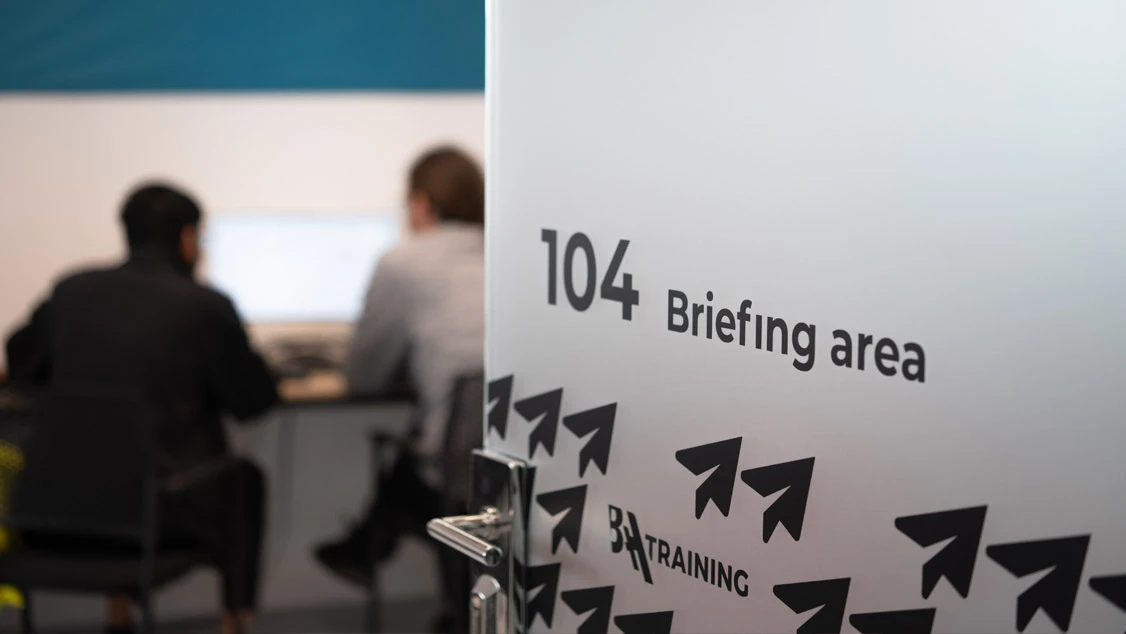
It is a theoretical part of your training that you complete in our ground school in Vilnius, Lithuania.
The ground school in Vilnius, the capital of Lithuania, is next door to the BAA Training simulator training center and a 10-minute drive away from the buzz of the beautiful old town.
Flight school: Lleida-Alguaire
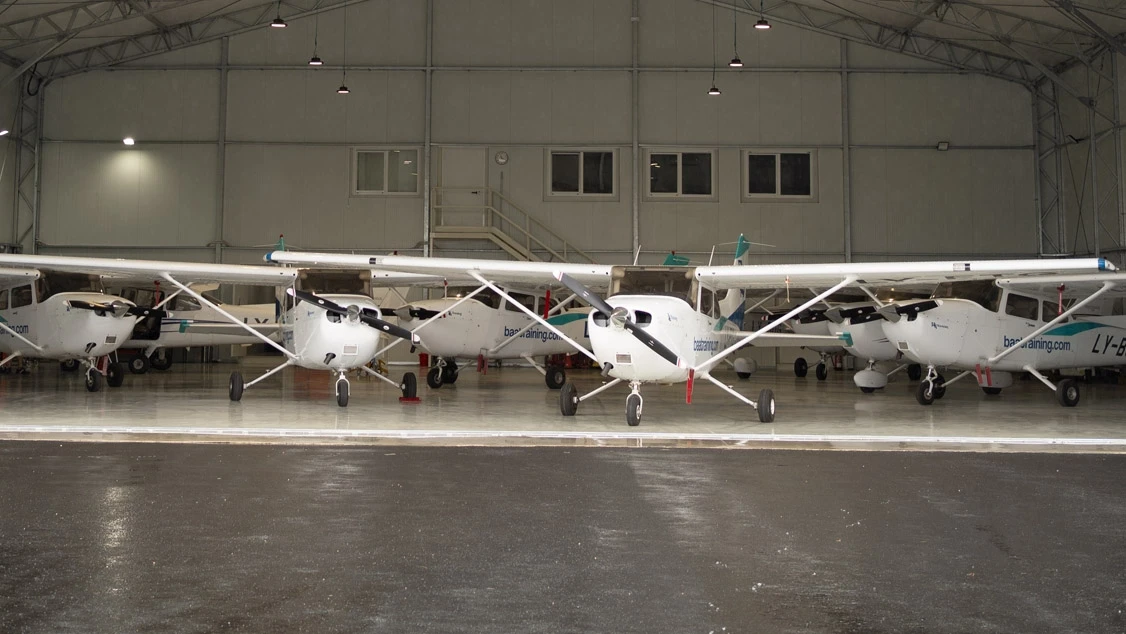
You will practice on Cessna and Tecnam types of aircraft and an FNPT II device.
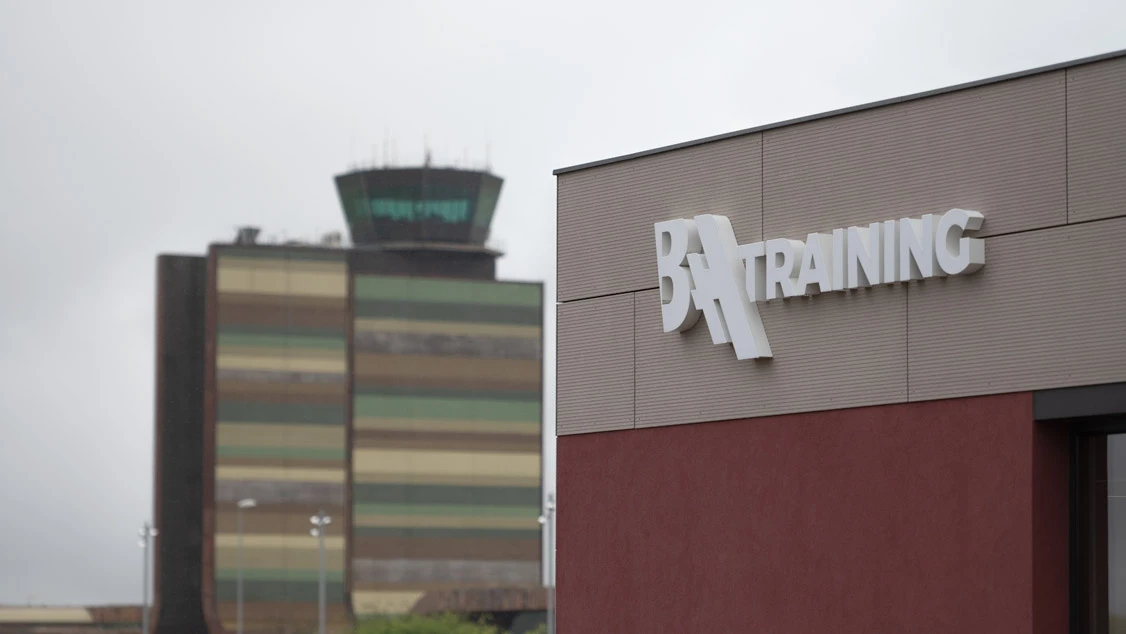
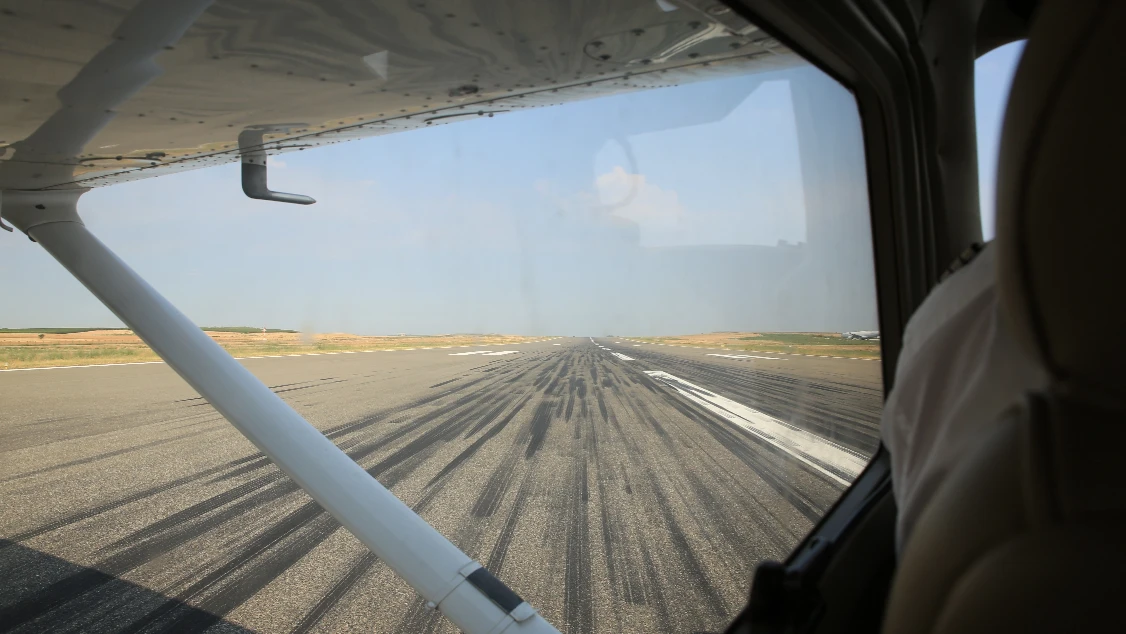
Our main flight base is in Spain, at Lleida-Alguaire International Airport. It offers a convenient location, well-developed infrastructure, and a suitable climate for year-round training.
Type Rating: Vilnius or Barcelona
You will get your Type Rating training in one of our simulator training centers – in Vilnius, Lithuania, or Barcelona, Spain.
The training center in Vilnius is equipped with two A320s, B737 NG, and B737 CL full flight simulators.
The training center in Barcelona is equipped with A320ceo, A320ceo/neo, B737 MAX FFS, A320 FTD Level 2, B737 MAX FTD Level 2 (2022).
Both facilities feature modern classrooms, briefing rooms, a spacious lounge to rest and a dining room.
ENTRY requirements
Age
At least 18 years old
Reputation
No criminal record
EU Citizenship
Unrestricted right to live and work in the EU
Knowledge of Physics and Math
These subjects form the basis of aviation studies, and knowledge of them will be tested during the entry assessment
Physical Status
Valid EASA 1st Class Medical Certificate
English Language Proficiency
At least level B2
Education
Secondary or higher
Other
Copies of relevant documents, e.g., passport, proof of a positive credit history, etc.
Fill out the enquiry form and a dedicated BAA Training manager will contact you to set up the first consultation.
First consultation
Your personal BAA Training manager will contact you at an agreed time to discuss the program in detail and answer your questions.
Medical checkup
You will have to submit a valid EASA Class 1 Medical Certificate—specialized medical examination for the pilot’s profession—and other required documents.
Document screening
You will complete a detailed candidate application form and submit the required documents. An agreed-upon initial candidate assessment date and time will be scheduled.
Initial candidate assessment
The 3.5-hour assessment is conducted via the Aon Assessment Solutions platform, either at our Vilnius training center or online. It includes:
Assessment of personal traits and competencies
English language proficiency assessment
Cognitive abilities and skills assessment
Interview with a pilot assessment specialist
The individual interview with an assessment specialist helps assess your motivation and overall readiness to begin pilot studies and pursue a career in aviation.
Assessment price: €1,000
Airline assessment & interview
In the final stage of the selection process, you will have a personal conversation with a psychologist and will need to provide relevant references. You will also participate in group exercise, as well as complete the final interview with the selection committee. This allows them to make the final decision about your suitability for pilot studies.
AIRLINE-BACKED Loan
One of the biggest benefits of the Pilot Runway program is the option to finance your training through an airline-backed loan. It’s a smart financial solution designed to ease the upfront cost and make your path to the cockpit more accessible.
Airline Loan
Cover your training costs with a loan from your future employer.
Repay After
Start repaying the loan only after you begin working as a First Officer.
Full Training
Training cost covers the complete MPL training—from Ground School up to Line Training.
PROGRAM COST breakdown
The total cost of the program is approximately €115,000, consisting of an upfront payment of €10,000 made by the cadet, paid only upon successful assessment, and a €105,000 loan provided by the financing partner—one of our program airlines.
As a Pilot Runway cadet, you have the option to finance your training through an airline-backed loan, offered by our partner airlines—Avion Express and AirExplore.
This means that after making an initial payment yourself, the remaining cost is covered by the airline you’ll eventually fly for.
You only begin repaying the loan once you start working as a First Officer at that particular airline.
Before you commit, we’ll guide you through the whole financial plan, step by step—so that you know exactly what to expect. If you’re eligible, you could start your training with a much smaller upfront cost and repay the rest once you’re working as a First Officer.
What does this study program include and how long does it take to complete?
Is the training recognized internationally, or only by specific airlines?
Can I combine Pilot Runway studies with work?
How much does Pilot Runway program cost?
Do I need to pass Math and Physics exams to become a pilot?
Why do I need a good level of English?
How can I prepare for the selection process?
How does the selection process for Pilot Runway differ from applying to a university?
Where will I work after completing the Pilot Runway program?
Is it a permanent working contract?
Is a university degree required for employment at airlines?
Is there an age limit, and do I still have a chance if I’m over 35?
Why can’t I apply if I’m not from one of the program countries?
What is ACMI?
What does this study program include and how long does it take to complete?
The full program typically takes around 2 years to complete, although the exact duration may vary depending on how quickly you pass the required exams set by the Civil Aviation Administration (CAA).
Is the training recognized internationally, or only by specific airlines?
Yes, the training is internationally recognized. BAA Training is an Authorized Training Organization (ATO), and graduates receive an MPL, which qualifies them to work as a First Officer.
Can I combine Pilot Runway studies with work?
No, the Pilot Runway program is intensive and fast-paced compared to other training programs. Classes take place daily—including weekends—and usually run for 6 to 8 hours a day.
On top of that, students are expected to spend a significant amount of time on self-study. You also cannot miss more than 20% of the lectures for any subject without a justified reason, as per the Student Code of Conduct. So, due to the demanding schedule and strict attendance rules, it’s not possible to balance this program with a job.
How much does Pilot Runway program cost?
The total cost of the Pilot Runway program is €115,000 and the assessment fee is €1,000.
As a Pilot Runway cadet, you’ll have the option to finance your training through an airline-backed loan. This means that after making an initial payment yourself, the remaining cost is covered by the airline you’ll eventually fly for. You’ll only begin repaying the loan once you start working as a First Officer.
To qualify for the loan, you’ll need a guarantor—someone who agrees to take on the responsibility if you’re unable to repay it.
Before you commit, we’ll guide you through the full financial plan, step by step—so you’ll know exactly what to expect. If you’re eligible, you could start your training with a much smaller upfront cost and repay the rest once you’re working as a First Officer.
Do I need to pass Math and Physics exams to become a pilot?
Your grades in Math and Physics won’t impact your chances during the selection process. However, having a solid foundation in these subjects from school will definitely come in handy—both during the selection and throughout your training.
Why do I need a good level of English?
English is the international language of aviation, so a strong grasp of it is essential. All exams, assessments, and communication during training will be conducted in English—both on the ground and in the air.
How can I prepare for the selection process?
The selection process includes stages of tests and interviews. The skill test checks your knowledge in physics, mathematics, and logic, as well as certain specific abilities. To prepare, it’s a good idea to brush up on these subjects as well as practice with joystick – and pedal-based computer games to sharpen your coordination and reaction time.
Getting familiar with basic aircraft instruments – like altitude, speed indicators, radar, compass, artificial horizon, heading indicator, and radio frequencies – will also give you a valuable edge during both the test and your future training.
Short-term memory is another key skill to work on. You can improve it by playing memory-boosting online games. It also helps to become comfortable using a keyboard, as quick and accurate typing can be useful throughout the process.
When it comes to the interview, be ready to clearly explain why you want to become a pilot and what steps you’ve already taken toward that goal. Your motivation and understanding of the profession will be a big part of your success.
We recommend doing some research beforehand – read up more about our partner airlines, and learn as much as possible about what the job actually involves. This will help you make an informed choice and show the interviewers that you’re genuinely committed and well-prepared for this career.
How does the selection process for Pilot Runway differ from applying to a university?
Unlike university admissions, which often rely on your high school diploma results, the Pilot Runway selection process takes a more holistic approach. Your acceptance is based on your performance across all stages: document screening, tests, and interviews.
Once you’ve submitted the required documents and met the basic eligibility criteria, you’ll move on to the next stage—similar to university entrance exams. This includes personality assessments, skill tests, and interviews with selection specialists and psychologists.
It’s a more in-depth process designed to evaluate not just your academic background, but also your potential to become a successful airline pilot.
Where will I work after completing the Pilot Runway program?
One of the biggest advantages of the Pilot Runway program is the job guarantee. Our current airline partners—Avion Express and AirExplore—guarantee successful graduates a First Officer position with their crew. That’s the charm of Pilot Runway: complete the training, and you’re cleared for takeoff into your pilot career.
Is it a permanent working contract?
Yes, after successfully completing the MPL training program, you’ll receive a permanent employment contract with the airline. Just like any standard job, there’s no set end date—it’s a long-term position as a First Officer.
Is a university degree required for employment at airlines?
No, you don’t need a university degree to become an airline pilot. What really matters to airlines are your professional qualifications—specifically, your commercial pilot license and aircraft Type Rating. These are what qualify you to fly, and they’re entirely separate from a university degree.
Is there an age limit, and do I still have a chance if I’m over 35?
There is no official age limit to apply for the Pilot Runway program. Everyone who meets the entry requirements is welcome to go through the selection process.
However, it’s worth noting that as age increases—especially beyond 35—success rates for the initial assessment, like the psychotechnical and psychomotor tests, tend to decrease. Older candidates may also face more challenges during the intensive training phase.
That said, motivation, preparation, and strong performance at each stage remain the key factors, regardless of age.
Why can’t I apply if I’m not from one of the program countries?
At the moment, the Pilot Runway program is open only to citizens of Bulgaria, Romania, Lithuania, Poland, and Slovakia.
This is due to current partnerships and regulations, but we’re always exploring opportunities to expand access in the future – so stay tuned!
What is ACMI?
ACMI stands for Aircraft, Crew, Maintenance, and Insurance. It’s a type of airline model where they provide these four elements to another airline that needs extra support—often during busy travel seasons or to cover specific routes.
For pilots, ACMI offers a unique way to gain international flying experience. Since aircraft and crew are often deployed across different countries and airline networks, it’s a fast-paced environment where you can build flight hours, adapt to various operations, and grow professionally—especially early in your career.
TESTIMONIALS
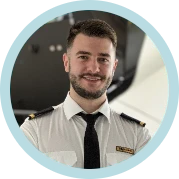
This dream is realistic—so, here I am.
The instructors are highly professional and ensure we fully understand each subject. The atmosphere at BAA Training is welcoming, and it’s been amazing to train alongside people from different backgrounds and cultures.
Milan Petki
Pilot Runway Cadet at BAA Training
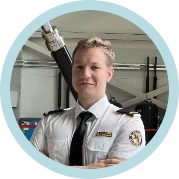
The studies are demanding but rewarding.
The instructors are highly professional and ensure we fully understand each subject. The atmosphere at BAA Training is welcoming, and it’s been amazing to train alongside people from different backgrounds and cultures.
Linas Cekatauskas
Pilot Runway Cadet at BAA Training
No better way to make your dream real.
It’s an amazing feeling to know that my dream is actually coming true, and working toward it with a group of people who share the same passion for aviation makes learning easier and the whole journey even more enjoyable. I didn’t expect people here, in the academy, to be so supportive. They really take care of us, always helping with any questions or problems. The schedule is planned so well that I can prepare properly for exams and still enjoy my free time. Vilnius has really surprised me; there’s so much to explore.
Kamil Sklodowski
Pilot Runway Cadet at BAA Training
It’s exciting to see how much there is to learn.
The Pilot Runway program provides a supportive, professional, and motivating environment that prepares you thoroughly for a successful career as a pilot. Dedication and discipline are key, and this program offers great support to help you achieve your goals. Being part of a team with like-minded, passionate students is truly inspiring. We encourage and motivate each other, share valuable experiences, and this camaraderie makes the learning journey in aviation exciting and enjoyable. It’s exciting to see how much there is to learn and how every piece of theory plays an important role in flying, which really motivates me to study further.
Toma Lucian
Pilot Runway Cadet at BAA Training
You will be here to fulfill your dreams of flying.
Prepare yourself and especially your mind for a huge amount of knowledge to gain in a short period of time. A good thing to keep in mind is that you will be here to fulfill your dreams of flying, and that is not easy.
This website uses cookies. You can express your preference for cookies by selecting one of the options below. If you select the “Allow” option, you agree to the use of all types of cookies, including third party and marketing cookies. You can change your cookie settings or withdraw your consent at any time by clicking on the “Cookie Settings” . Your consent is not required for the recording of the strictly necessary cookies. For more information, please read our Cookie Policy
Cookies settings
We use cookies and other similar technologies to help provide our Services, to advertise to you and to analyse how you use our Services and whether advertisements are being viewed. We also allow third parties to use tracking technologies for similar purposes. If you are using our Services via a browser you can restrict, block or remove cookies through your web browser settings.